
Welcome to Trading as a Newbie
If you just arrived here, take a deep breath. You are in a rare corner of the internet where nobody is going to try to sell you a $2,997 “secret indicator course,” promise you passive income from a beach in Bali, or push you into a 1:500 leveraged offshore CFD account.
Learning to trade financial markets is a genuine, rewarding skill — much like learning to play chess, fly an aircraft, or master strength training.
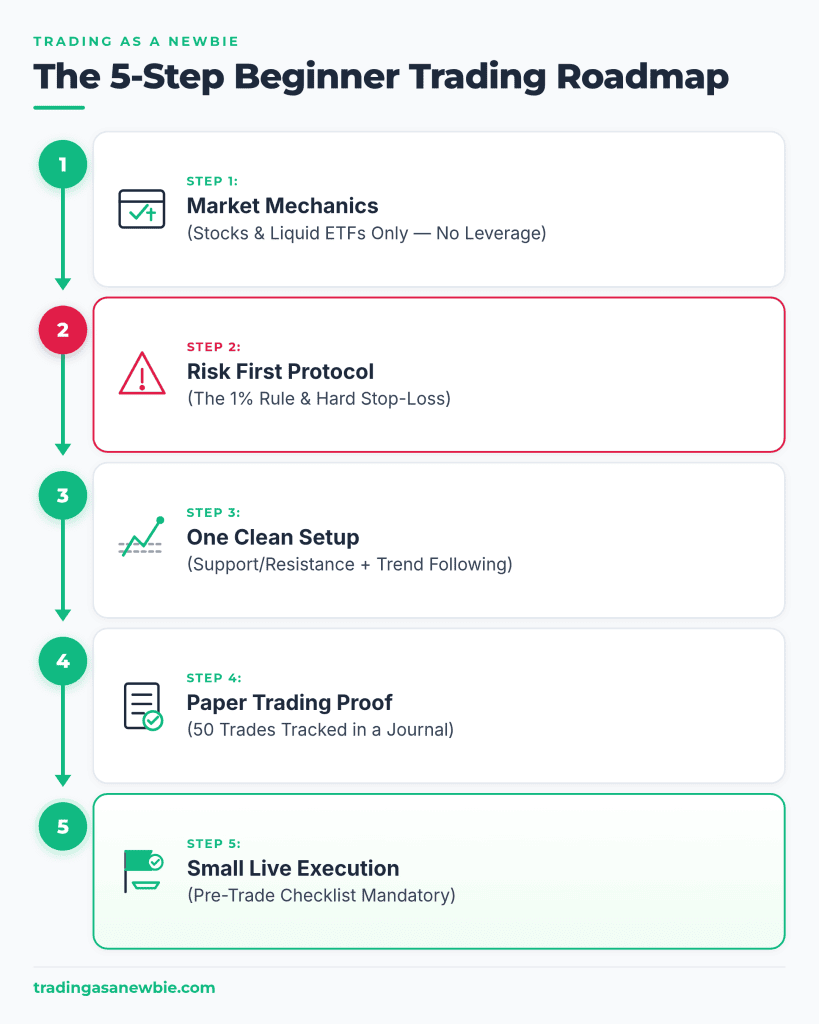
However, 90% of beginners fail in their first six months for one simple reason: they jump straight to Step 5 (placing live money trades) before building Steps 1 through 4.
Bookmark this page. Follow these five steps in exact chronological order, and you will save yourself thousands of dollars in “market tuition.”
Protect Your Capital
The 1% Rule and strict risk management.
Clean Price Action
No indicator overload. Trade what you see.
Master Your Mind
Overcome FOMO and stop revenge trading.
Step 1: Understand the Machine (Market & Order Mechanics)
Before you look at a single candlestick chart, you must understand who sits on the other side of your trade, how the order book matches buyers and sellers, and why choosing the wrong asset class or order type will sabotage you from day one.
- Core Rule of Step 1: Focus 100% on liquid Stocks and ETFs during your first 6 to 12 months. Ignore leveraged CFDs, binary options, and short-term weekly options completely until you have a proven track record.
Required Reading:
- How the Stock Market Works: A Complete Beginner’s Guide (Understand the auction, bid-ask spreads, and market makers)
- Asset Classes Explained: Stocks, ETFs, Options & CFDs (Why choosing the right vehicle protects your capital)
- Understanding Order Types: Market, Limit, and Stop Orders (How to prevent slippage and automate your safety net)
Step 2: Master the Math of Survival (Risk Management First)
Amateur traders obsess over “How much money can I make on this trade?”
Professional traders obsess over “How much money will I lose if I am dead wrong?”
You do not need a 90% win rate to make money in the stock market. With a strict 1:2 Risk-to-Reward Ratio (RRR), you can be wrong 60% of the time and still grow your account steadily — provided you never let a single bad trade blow up your capital.
- Core Rule of Step 2: Never risk more than 1% of your total account equity on any single trade idea. Your stop-loss distance dictates how many shares you are allowed to buy.
Required Reading:
- The 1% Rule: How to Protect Your Trading Capital
- How to Calculate Position Size Based on Stop Loss
- Understanding Risk-to-Reward Ratio (RRR) in Trading
Step 3: Learn Clean Price Action (Technical & Fundamental Context)
Once your risk shield is locked in, it is time to learn how to read charts and market catalysts. Forget cluttering your screen with fifteen conflicting indicators. You only need to understand market structure, supply and demand zones, and when major news events are scheduled.
- Core Rule of Step 3: Trade on the Daily (1D) chart first (Swing Trading). It fits seamlessly around a full-time job and filters out the chaotic noise of 1-minute day trading charts.
Required Reading:
- How to Identify Support and Resistance Levels (Drawing zones, not thin lines)
- Candlestick Patterns 101: Doji, Hammer & Engulfing (Reading price rejection at key levels)
- Essential Trading Indicators: RSI, EMA & MACD (Keeping your chart clean)
- How to Trade Economic News & Fed Announcements (Never get blindsided by Fed announcements)
- How Quarterly Earnings Move Stock Prices (Never get blindsided by earnings gaps)
Step 4: Prove It in the Simulator (50 Paper Trades + Journaling)
Would you step into the cockpit of a commercial jet without spending 100 hours in a flight simulator? Of course not. Yet thousands of beginners deposit hard-earned savings into a broker and start clicking buttons without knowing if their strategy actually works.
- Core Rule of Step 4: Open a free Paper Trading account, set the virtual balance to match your real-world starting budget, and log 50 simulated trades following your written rules before risking a single dollar of real money.
Required Reading:
- The Beginner’s Guide to Paper Trading: Practice Without Risk
- Why Keeping a Trading Journal Makes You Profitable
- Overcoming FOMO: The Trader’s Greatest Enemy
- How to Stop Revenge Trading After a Loss
Step 5: Your Pre-Trade Protocol & Phased Live Launch
Once you have proved positive expectancy over 50 paper trades, you are ready to transition to a regulated live brokerage account with small position sizes.
To keep emotions out of the driver’s seat, every single trade you take must pass a strict Pre-Trade Checklist before you click “Buy.”
Download Your Free 5-Point Pre-Trade Checklist
Keep our 5-Point Pre-Trade Execution Card next to your monitor and verify every trade against these five gates:
- Catalyst Check: No earnings or Fed announcements in the next 48 hours.
- Invalidation Level: Stop-loss is placed at a logical chart structure level.
- 1% Position Sizing: Exact share count is calculated from your stop-loss distance.
- Asymmetric Reward: Realistic target offers at least a 1:2 Risk-to-Reward Ratio (RRR).
- HALT Mindset Check: Zero FOMO, zero boredom, zero revenge trading.
Risk Disclaimer: Trading financial assets involves substantial risk of loss and is not suitable for every investor. The content on tradingasanewbie.com is published strictly for educational and informational purposes and does not constitute financial, investment, or trading advice. Never risk capital you cannot afford to lose.